
August 1935
"The Sun Also Rises"
by the Pan Am Historical Foundation
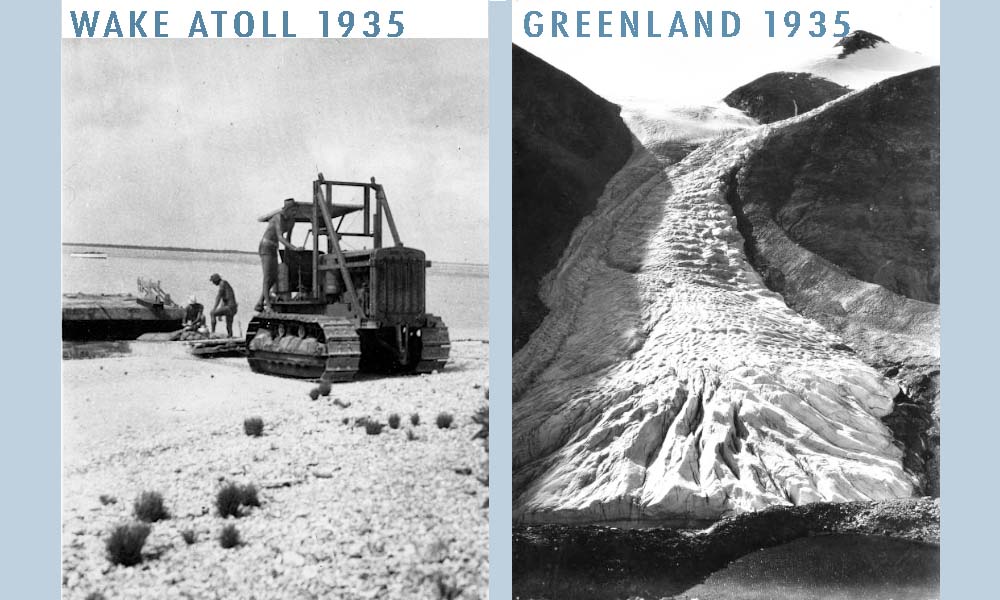
1935 Photos: (left) Wake Island construction (George Kuhn/PAHF); (right) East Greenland by Louise Boyd (Archives of the American Geographical Society, University of Wisconsin, Milwaukee) No. 336-01. https://collections.lib.uwm.edu/digital/collection/agsny/id/65603/rec/6
Two Oceans
Pan American stole headlines building its transpacific air route, but few noticed that the airline was quietly backing another effort across the top of the world towards Europe. While Pan Am chased the sun westward across the Pacific Ocean forging an air route to Asia via tiny Wake Island, Juan Trippe was strategizing in the opposite direction, across another ocean on the world's largest island, 11 time zones to the east.
It was a telling coincidence that on August 17th, 1935, the very date that Captain Rod Sullivan set down the Pan American Clipper on Wake's Lagoon, for its third Pacific survey flight, Lt. Paul Jensen of the Danish Air Force took off by air to conduct a meteorological survey of East Greenland for Pan Am. The wind-swept, cold environs of Greenland were being explored and studied as a likely linchpin for a northern air route across the Atlantic.
Greenland & Iceland
Trippe had always had his global gaze set on tapping the rich transatlantic trade. In the 1930s limited aircraft range made it imperative to find practical stopover bases. Greenland, and Iceland further east, were obvious choices. The problem, particularly regarding the Danish territory of Greenland, was its remoteness and harsh sub-Arctic climate.
But the route offered one obvious advantage: it most closely matched the shortest flight path between the New World and the Old World, thanks to its approximation of "Great Circle" routing.
Aviation empire-builder Trippe grasped this reality early on, and he strategized accordingly, starting long before 1935.
-In 1931, at Pan Am's bidding, Charles and Anne Lindbergh charted a course to Asia across northern latitudes in their Lockheed Sirius.-In 1932, Juan Trippe pushed Pan Am into northern operations in Alaska, forming Pacific Alaska Airways, where cold weather operations were a necessity.-Two years later, in 1933, the Lindberghs undertook an even more exhaustive survey to Europe and around the Atlantic basin, carried out in close cooperation with an entire Pan Am-supported expedition on the SS Jelling, a chartered Danish ship. The resulting data and report proved instrumental in providing actual parameters for Pan Am about flight conditions in Greenland and Iceland.
Geopolitics & Logistics
Unlike the all-US territory in Pan Am's mid-Pacific airway, flights to Europe had political as well as logistical challenges. In 1932 Juan Trippe, with a talent for international relations, secured preliminary agreements with the Danish government to start scientific surveys for future air routes across the Greenland and Iceland territories. This evolved into a more active arrangement permitting potential trial flights to begin in 1936 and 1937.
The Beginnings of the Viking Trail Route
With the green light from Denmark, Pan Am took advantage of opportunities to back the efforts of explorers and scientists from Canada, Denmark, and Britain to expand Pan Am's knowledge about forging the "Viking Trail" route.
-In 1932 and '33, Pan Am sponsored both a West Greenland Expedition organized by the University of Michigan as well a a separate East Greenland Expedition with the British Royal Geographical Society.-In 1934, Pan Am heavily subsidized the Rockwell Kent expedition to Northern Greenland.-Pan Am sponsored other work as well, as described in a company memo:
"(The airline employed) various Danish and Icelandic aviators, explorers and scientists. Captain A. P. Botved, a well-known Danish flier, worked for the airline in Greenland from 1933 until his country was overrun by the Germans. Danish Naval Lieutenant Kurt R. Ramberg * made an aviation study for the airline for a year starting in 1935 in West Greenland as did Lieutenant Poul Jensen ** of the Danish Air Force in East Greenland." ("Notes on Pan Am's Arctic Experience 1955" (University of Miami Special Collections) pp. 18-19.
Intercontinental Non-Stop
Until there were airliners that could safely carry passengers over the Atlantic Ocean from Newfoundland in the West, to landfall in Ireland in the East without stopping - and back again - the route over the "Viking Trail" via Greenland and Iceland offered the optimal path to take advantage of a "Great Circle" route to Europe.
As it turned out, the sub-Arctic air route - the shortest way between the continents - would be deferred until the world's unsettled geopolitical conflicts were sorted out in World War II. But the intensive work of an international group of scientists, explorers, and aviators backed by Pan Am helped pave the way towards the coming age of modern air travel as we know it.