WAKE: A KEY LINK IN THE PACIFIC
S-42 Pan American Clipper Survey Landing
August 17, 1935
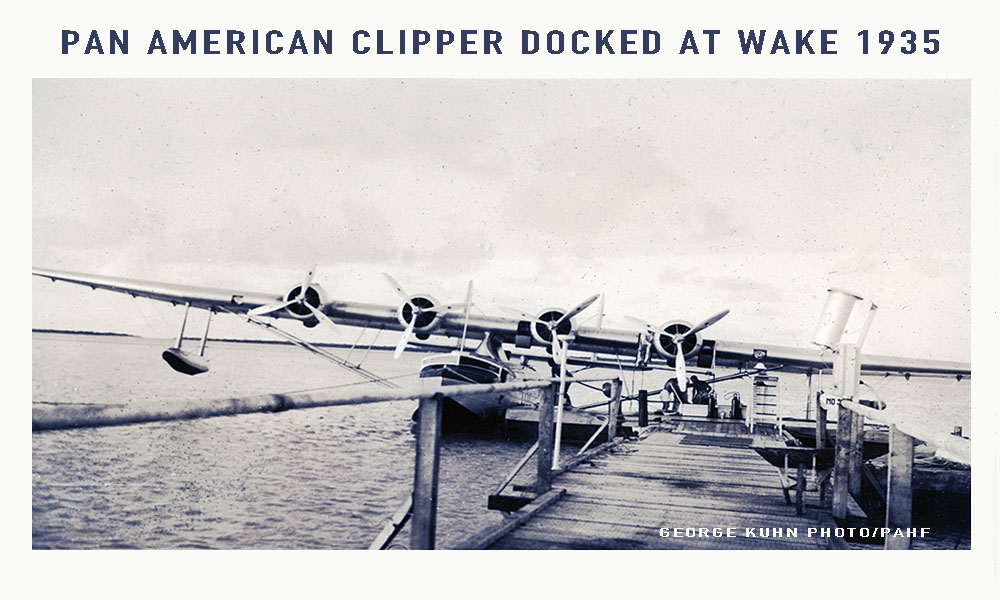
While Ed Musick went back to Maryland to familiarize himself with the new Martin M-130 (to be delivered to Pan Am in early Oct.), Capt. R.O.D. Sullivan took over command of Pan Am's survey flight schedule. He flew the third survey to Wake in August 1935, and the fourth survey to Guam in October 1935.
Wake atoll was a key link in the Pacific air route to Asia because it was the only place for 3,000 miles where Pan Am flying boats could land to refuel between Hawaii and Midway, on the way to Guam & Manila. In fact, it was a miracle for Juan Trippe that Wake was situated where it was in the Pacific, and that it also happened to be a legal possession of the United States.
The third survey flight with Pan Am’s S-42 American Clipper stopped first at Hawaii, then Midway, and finally Wake. Hawaii and Midway were already known quantities (as well as Guam to the west), but the uninhabited islands of Wake presented some real challenges. The atoll was a hostile environment, never previously settled, and it took a significant effort for Pan Am to make it habitable.
The objective on Wake was clear. Construction and logistical teams arrived in early May and set out to build the base well ahead of the two remaining survey flights. Their hard work began after they'd offloaded tons of equipment, including tools and machinery for buildings and infrastructure, from the USS North Haven.
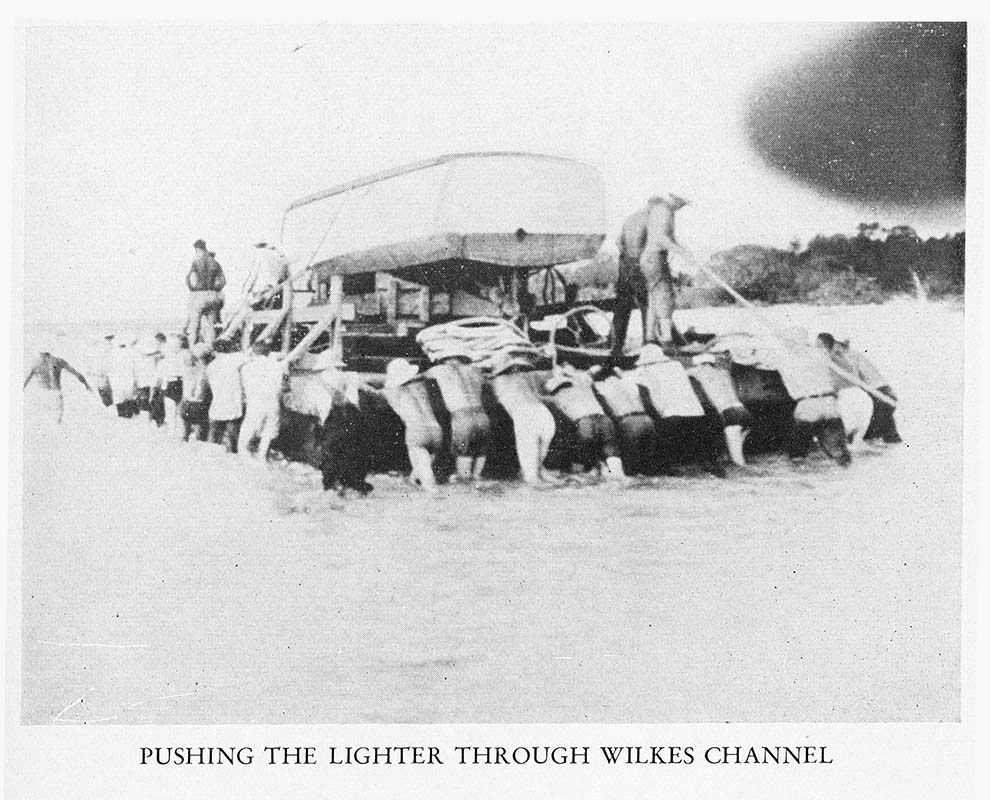 Photo from Grooch, "Skyway to Asia"(1937) pp. 106-107.
William Grooch, Pan Am project manager for the Pacific bases, wrote detailed accounts of the hardships at Wake in his book,"Skyway to Asia," and in his reports to Pan Am. On Wake the most crucial resource, fresh water, was only available from scant rainfall that didn’t provide enough fresh water for such a large number of men working long hours in the tropical sun. Drilling down into the island soil only revealed more sea water. The North Haven could provide supplies while anchored at Wake, but would be leaving for Guam in early July. That necessitated creating stills on the island to extract potable water for everyone. It solved the drinking water problem, but the men continued to use salt water for showers.
Despite the rugged conditions, most of the Wake base was in operational condition when the Pan American Clipper arrived in August 1935, an astounding feat considering the difficulties the Wake crews faced. The lagoon landing area, even after weeks of blasting to clear it of coral heads, still had to be extended before Pan Am’s regular service across the Pacific could begin.
The Third Survey Flight
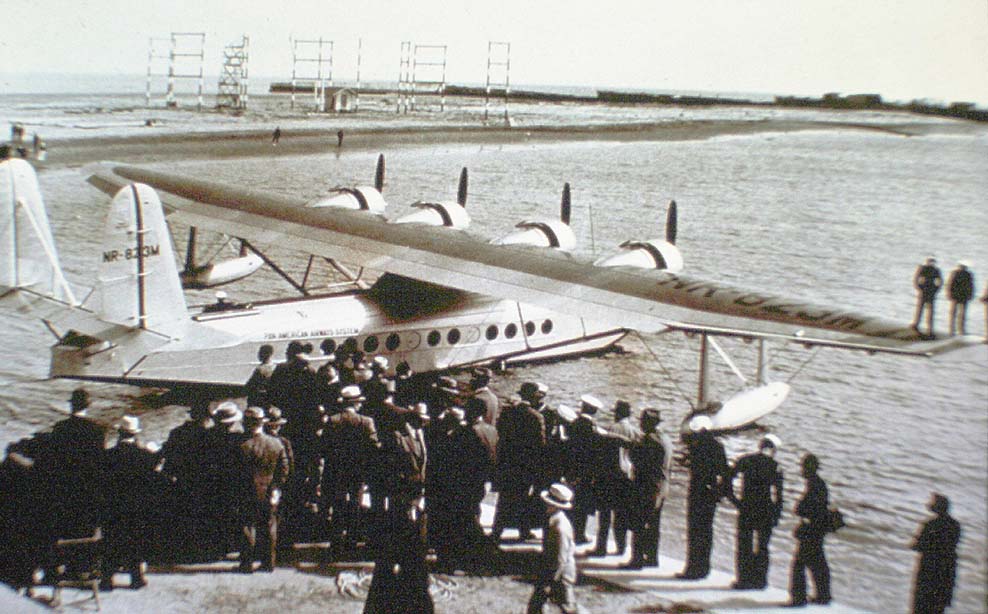
S-42 Pacific Survey Aircraft: Pan American Clipper NR823M at Alameda (Pete Runnette/PAHF Collection).
◦ Pearl Harbor-Midway, 0609 Aug. 13 - 1329 Aug. 13, 1,137 mi.: 8 hrs. 50 min.
◦ Midway-Wake, 0520 Aug. 16 - 1229 Aug. 17. 1,062 mi.: 8 hrs. 9 min.
The Return, Wake Island to California
◦ Midway-Pearl Harbor, 0526 Aug. 22 - 1533 Aug. 22. 1,145 ml.: 10 hrs. 7 min.
◦ Pearl Harbor-Alameda, 1729 Aug. 28 • 1054 Aug. 29. 2,132 mi.; 17 hrs. 25 min.
The Wake Refueling Base
Under Grooch's guidance, Wake had made a huge transition from an uninhabited zone to a functional refueling and rest stop for Pan Am's S-42 surveys. Grooch made sure that Pan Am's essential infrastructure — the seaplane landing area, radio direction finding station, and supply transfer systems — were largely in place and ready to operate by the time he left:
◦ The Wilkes Island Railway had been completed and facilitated moving supplies from the USS North Haven.
◦ A small Pan Am office building had been constructed to serve as the administrative and operations center so staff could oversee the base and flight logistics.
◦ A functional Pan Am Adcock radio station and tower had been built.
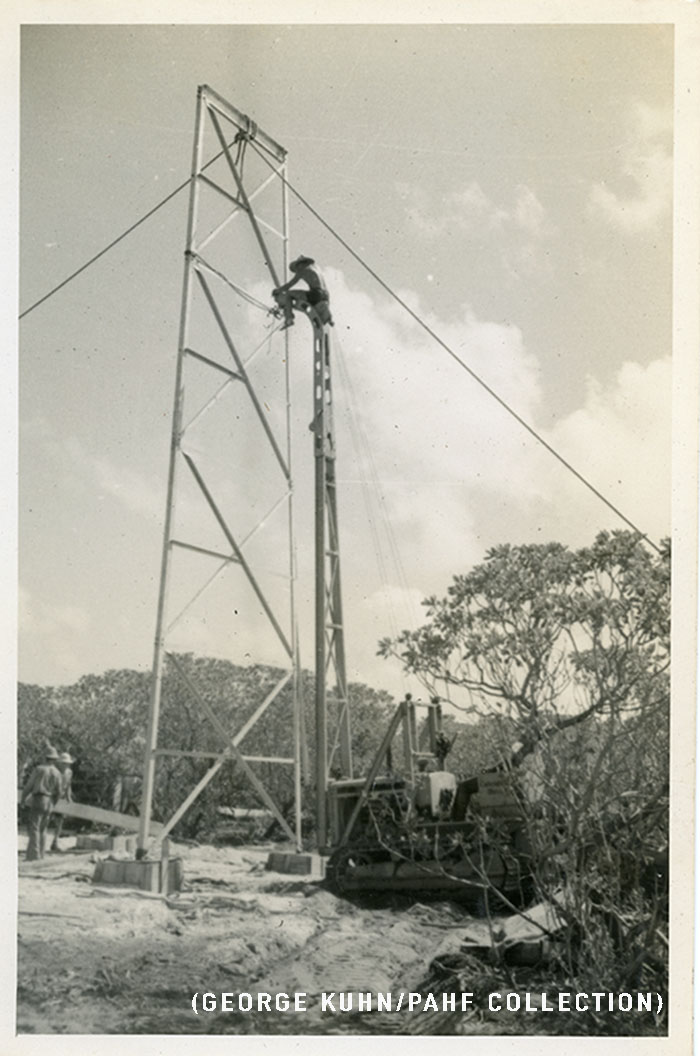
Installing the Radio Tower, Wake Island, by George Kuhn, Pan Am construction engineer (Kuhn/PAHF Collection).
“Recognizing the radio’s importance to over-ocean transport, Pan American Airways had, several years before 1935, employed experts in the field and concentrated them upon research, engineering, and field testing in connection with long distance, over-ocean communications problems.
Practically all of the radio equipment for the transpacific airway was either manufactured by Pan American's subsidiary [PAMSCO - Pan American Supply Company founded by Hugo Leuteritz and Ferris Sullinger in Miami] or modified by its engineers to meet the hitherto unencountered long distance problems.
The equipment met these requirements and proved stable, flexible and reliable.”
“History of the Transpacific Air Services to and Through Hawaii,” CAB Docket Nos. 851 et al. (1944) p. 14.
◦ Shelter for workers and employees included tents and some prefab huts.
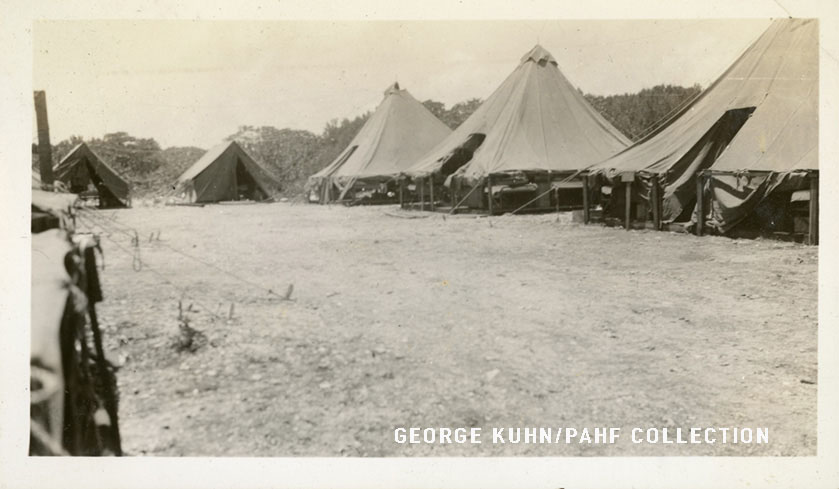 Photo by George Kuhn, Pan Am construction engineer, Wake Island (George Kuhn/PAHF Collection).
◦ Fuel storage was temporary but operational. Cargo offloaded in May from the SS North Haven included aviation fuel barrels stored on Peale Island.
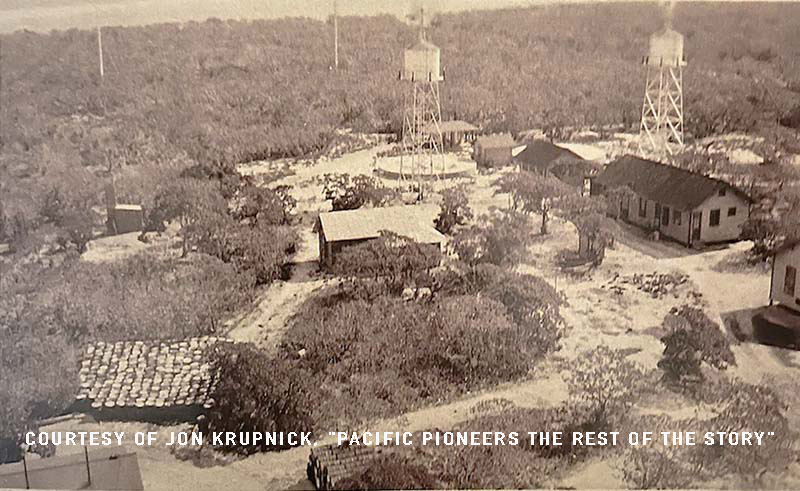
"General view of Wake vlilage showing barrrels of fuel" (courtesy of Jon Krupnick, "Pacific Pioneers The Rest of the Story") p.131 .
“Sully made our first landing and just got stopped in time.” **
The lagoon seaplane landing area was cleared and operational but was still short of the desired length to accommodate bigger flying boats for transpacific service. According to Robert Daley in his book, "An American Saga" the length of the restricted area that had been cleared of coral heads for the S-42 surprised Captain Sullivan when he first saw it.
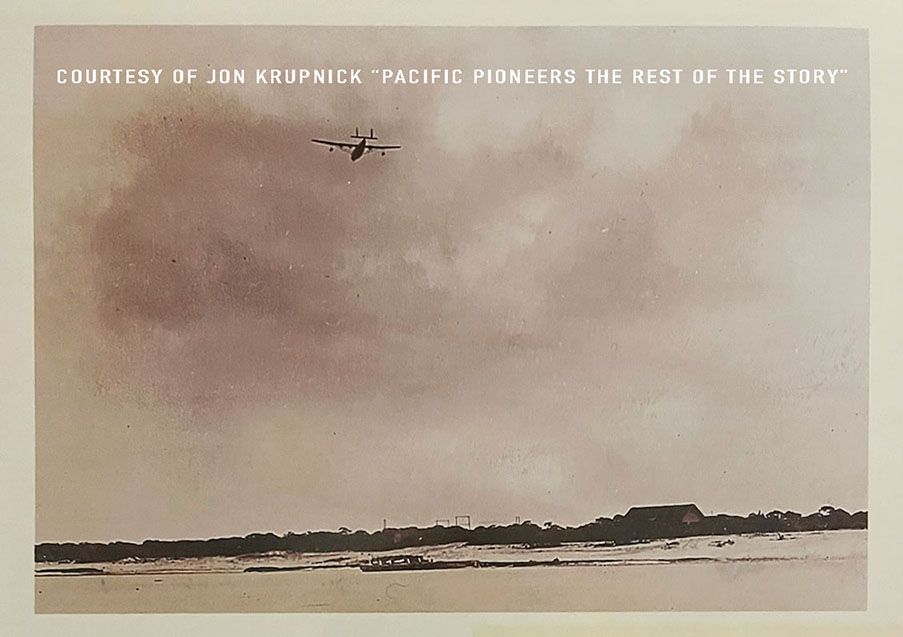
Pan Am Clipper arrives at Wake August 17, 1935. (Courtesy of Jon Krupnick, "Pacific Pioneeers, The Rest of the Story") p. 130.
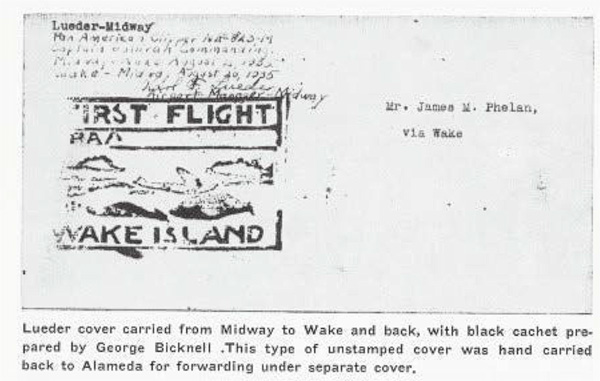
CACHETS
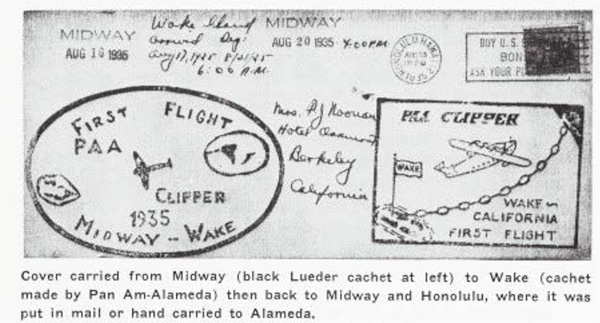
Cachets for the transpacific surveys remained popular mementos of the Pan Am's history-making journeys and were designed and prepared by a number of Pan Am personnel, according to aerophilatilist and historian John Johnson.
Wake Cachets, August 1935 probably prepared by navigator Fred Noonan (Courtesy of John Johnson).
“...no less than four cachets were used... Probably only a few covers were flown from Midway to Wake, for which an oval cachet was prepared by Karl Lueder... Pan Am in Alameda is said to have prepared the rectangular Wake-California cachet showing a map with a chain connecting the two and the seaplane headed for the mainland... The illustrated cover with both the oval and the rectangular cachets was probably prepared by navigator Fred Noonan..."
John Johnson, "The Airpost Journal, "April 1985, Vol. 56, No. 7, pp. 222 - 223.
Wake Cachet, Aug. 1935, mailed from Honolulu to Juan Trippe in New York City (Courtesy of John Johnson).
“Pan Am cover, one of undetermined number printed for Honolulu-Wake-Honolulu segments, with blue rubber-stamp cachet (prepared by Pan Am or U.S.Navy personnel at Pearl Harbor). signed by flight commander [ROD Sullivan], and log entries by Mldway and Wake airport managers Lueder and Bicknell.”
John Johnson, "The Airpost Journal, "April 1985, Vol. 56, No. 7, pp. 222-223
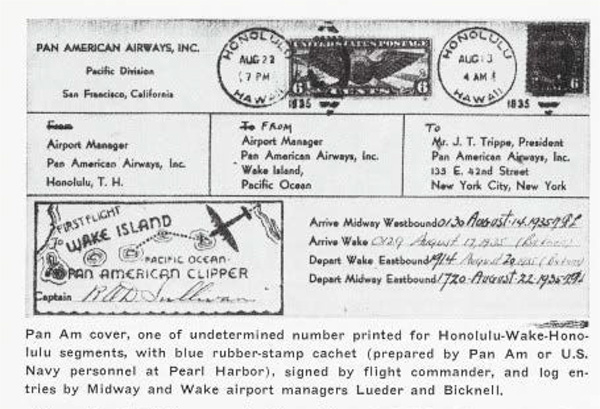
Wake Cachet Aug. 1935 prepared by George Bicknell (Courtesy of John Johnaon).
John Johnson, "The Airpost Journal, "April 1985, Vol. 56, No. 7, pp. 222 - 223.
Sources:
Daley, Robert. "An American Saga," (Random House ), 1980.
Grooch, William. "Skyway to Asia,"(Longmans, Green and Co.), 1937.
Grooch, William Pan Am Report, 1935 (PAHF Collection/original text at University of Miami Special Collections).
“History of the Transpacific Air Services to and Through Hawaii,” Civil Aeronautics Board Docket No. 851 et al. (1944) p. 14.
Krupnick, Jon. "Pacific Pioneers, The Rest of the Story,"(Pictorial Histories Publishing), 2000.
Kuhn, George. Wake Island Images, 1935 (Kuhn/PAHF Collection).
"PAA's 1935 Pacific Survey Flights" by John Johnson, Jr. , "The Airpost Journal," April 1985, Vol. 56, No. 7, pp. 220-223
Photo of Pan American Clipper at Alameda (Pete Runnette/PAHF Collection).