PAN AM - 1932
By Eric Hobson
NOVEMBER

“$3.75 Million Committed”
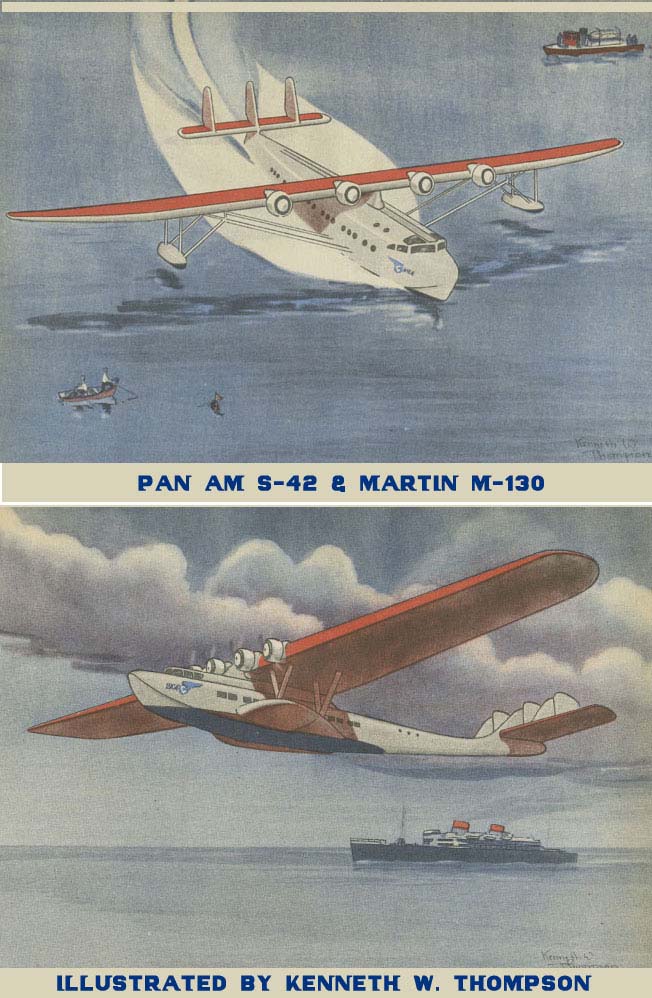
Photo Compilation: Pan Am Sikorsky S-42 and Martin M-130 illustrations by Kenneth W. Thompson, (Eric Hobson Collection).
90 years ago, on November 1, 1932, amidst a global financial crisis Pan American Airways stunned commercial aviation with two announcements: a $2,500,000 contract with Sikorsky Aviation Corporation for ten new aircraft; meanwhile, the first Martin M-130 (NC14716) keel was laid at Glenn Martin’s Middle River (Maryland) plant.
Both models were seaplanes -- 32-seat Sikorsky S-42; 41-seat Martin M-130 – and wildly expensive compared to the newest land planes. The 14-seat Douglas DC-2, cost $78,000 fully equipped (airframe, engines, radios), while the Sikorsky’s unit cost was $242,000, and the M-130’s $417,000. This thirteen aircraft and $3,751,000 purchase represented an unprecedented Pan Am commitment (~$81,000,000 in 2022 $US).
Pan Am President Juan T. Trippe was playing a long game, planning for transpacific and transatlantic service. The Martin M-130 “China Clipper” inaugurated transpacific airmail service three years later and the Sikorsky S-42’s made the Martin M-130 flight possible. Pan Am’s Chief Pilot, Ed Musick and crew, used S-42 (NC823M) to survey the transpacific route. Following Captain Musick’s death (January 11, 1938), Harold Grey, Pan Am’s new Chief Pilot, surveyed North Atlantic routes in 1940 aboard Pan American Clipper III (NC16736), the last S-42B delivered.
“Racing Cuban Bulls” on Pan Am's Fifth Airmail Anniversary”
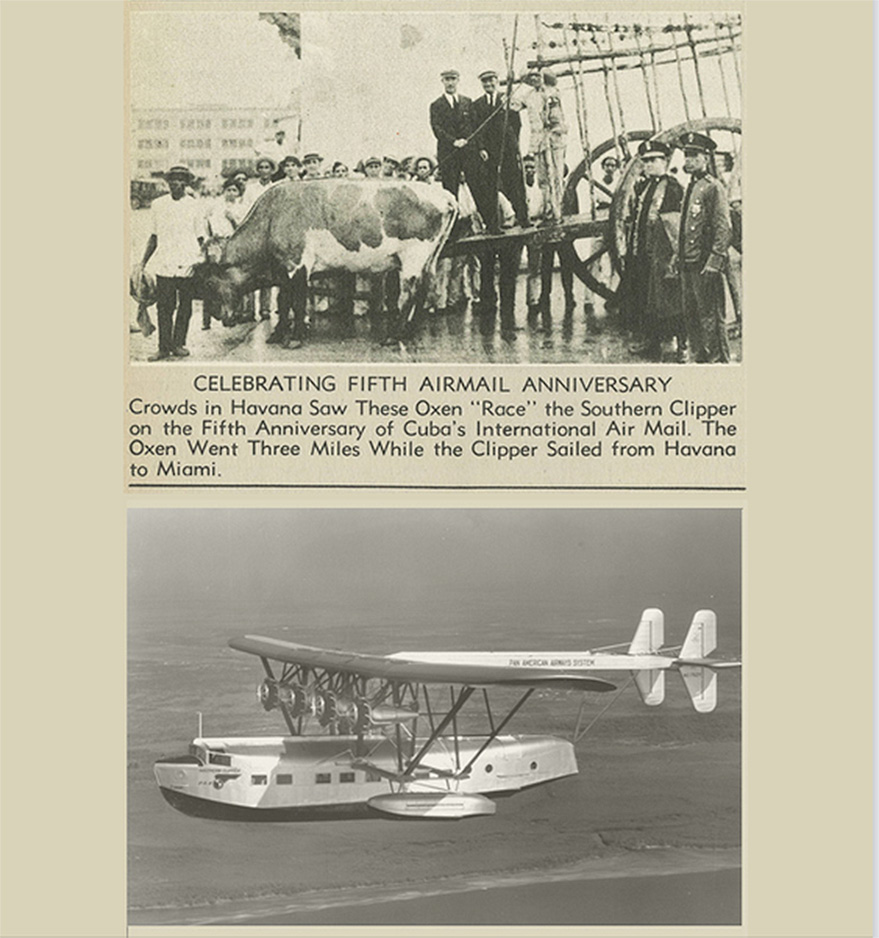 Photo Compilation: Celebrating Fifth Airmail Anniversary (@UM_Spec_Coll) / Sikorsky S-40 "Southern Clipper" (PAHF Collection).
The Sikorsky S-40 “Southern Clipper” (NC752V) raced an oxcart to celebrate five years of Cuba-United States airmail service. Two bulls, following police and a marching band, pulled a wood-wheel cart three miles from Havana’s center along the waterfront to a point beyond the Paseo del Prado while the Sikorsky flew 227 miles to Miami. As he headed northeast, Pilot Basil Rowe looked down on Havana’s thronged Malecón certain of a win.
Twenty-four years later, Rowe admitted that the race was actually competitive “because of three factors… foremost was the method used by Cubans in handling oxen: goading them with a nail in the end of a pole. The second factor was a northeaster that I had to buck. The third was the Cuban… love of gambling.”
Headwinds held the S-40’s under its 115 miles-per-hour cruising speed while the oxen enjoyed a tailwind. “Everyone… betting against the Clipper… started to push the cart and pull the oxen until the poor beasts were doing about ten miles an hour and gaining on me.” As Rowe passed Key West, his radioman announced the cart had a mile and a half to go; Pan Am’s team was an hour-plus from Miami.” Unlike the ox, Basil had no one “sticking a nail into the tail of the Clipper.”
“Something had to be done,” stated Basil. “I couldn’t louse up the publicity. Besides, the Cubans had been two-timing me all the way,” so “I pulled the throttles closed and set … down on a smooth stretch of protected water in the lee of the Keys. I radioed ‘Just landed,’ planed along on the step for half a mile or so, then pulled up and continued the flight.” “It was a dirty trick,” Basil admitted, “but so is sticking nails in oxen.”
“Flying into Devastation”
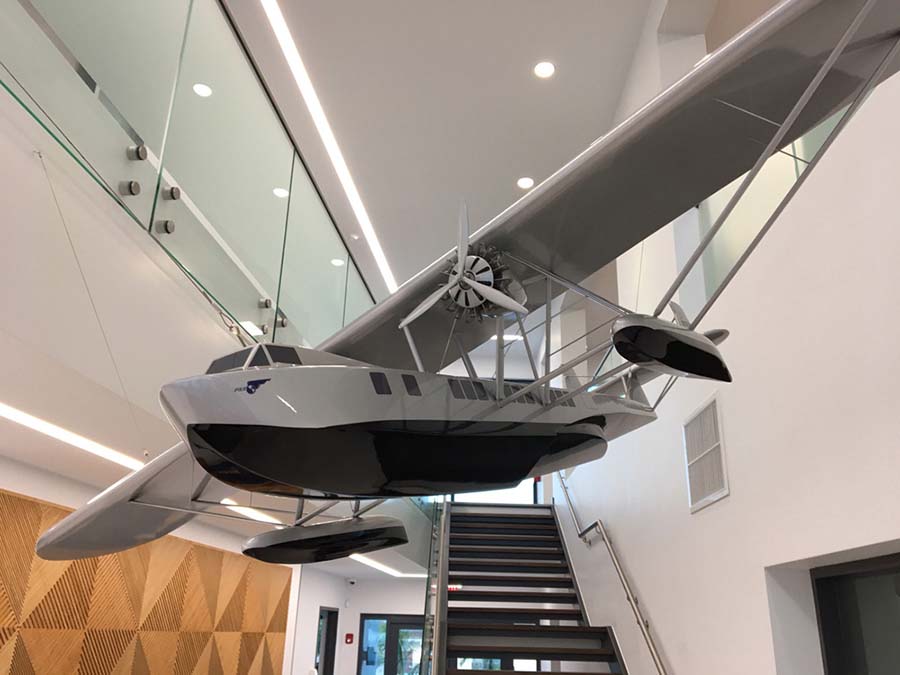 Photo by Alastair Robertson shows NC659M Pan Am Consolidated Commodore Model created by Roger Jarman and the crew of Atlantic Models Miami, now displayed at Cayman Civil Aviation Authority, Grand Cayman Island. Posted with permission.
Most Pan American Airway’s first flights into Central and South America countries were filled with pomp and celebration; Pan Am’s first flight to the Cayman Islands, Friday, November 11, 1932, however, was not.
Four days earlier, Monday, November 7, 1932, a super storm passing east of Grand Cayman blasted the island with 155 mile-per-hour winds and a 29.9-foot tidal surge. Cayman Brac, 100 miles east-northeast bore the hurricane’s brunt: blowing 200 miles-per-hour, the Category 5 storm hit Tuesday. Homes and trees that withstood the wind vanished as a 32-foot storm surge scoured the 1.2-mile-wide by 12-mile-long island. 109 residents died (a sizable percentage of Cayman Brac’s population) and, as a post-storm inspector noted, “This island has been reduced to a desert.”
Cayman had no radio telegraphs (the islands relied on inter-island shipping and the British Navy to send messages) so Britain’s western Caribbean administrators in Jamaica didn’t know of the hurricane hit. As reports recounted utter devastation across Cuba, including 3,033 killed -- 2,870 in Santa Cruz del Sur – British officials understood that Cayman had to have been hit. Pan Am offered to divert its next day Kingston-Miami flight to deliver aid and assessment personnel.
Flying Consolidated Commodore NC659M, Stanley “Red” Williamson left Kingston Harbor at dawn Friday for Grand Cayman (316 miles northwest) carrying, in addition to passengers and airmail, Mr. Allan Pullar, Assistant Surveyor of Customs, and all the relief supplies the aircraft could hold.
At George Town (Grand Cayman), Williamson dedicated the radio (and PAA’s radio system) to transmitting status and need reports, while he oversaw supplies transfer. Mr. Pullar stayed to continue his work when Captain Williamson left to complete the Kingston-Cienfuegos-Havana-Miami run.
NC659M’s November 11, 1932 landing was the Cayman Islands’ first. To commemorate its 90th anniversary, the Cayman Civil Aviation Authority commissioned a NC659M model to hang in its headquarters adjacent to Owen Roberts International Airport.
Sources:
McLaughlin, Heather R. (Ed.), "The `32 Storm, Cayman Islands," National Archive, 1994.
“Flights through Kingston: 1930-34,” Author’s database.
“Early Sloganeering”
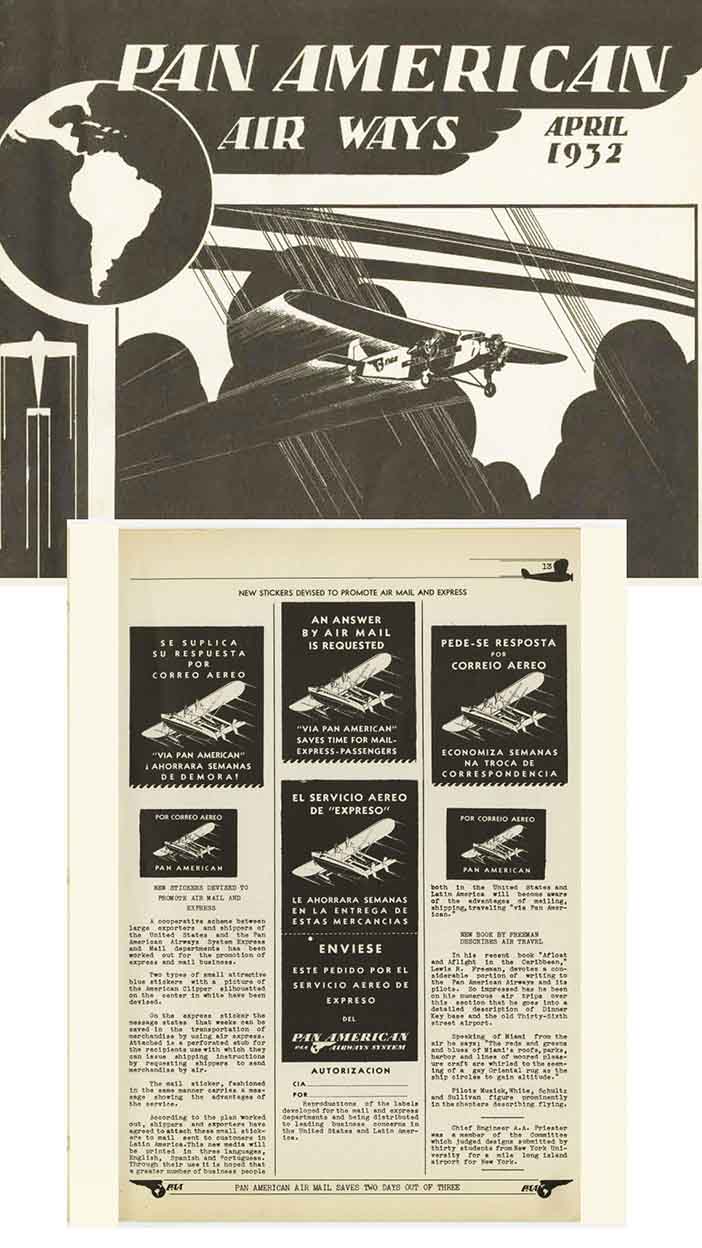
Photo Compilation: "Pan American Air Ways" cover and inside page showing Stickers for Pan Am Airmail and Express 13, published April, 1932. @UM_Special Collections).
Attentive “Pan American Air Ways” readers noticed a layout change in the company’s in-house newsletter. Starting with the April 15, 1932 issue, Pan Am’s communications department embedded a slogan at the bottom of each page emphasizing Safety, Service, and Air Mail. As they kept up with activity throughout Pan Am’s growing system, some readers may have paused for a moment to reflect on these missives.
In July of that year Pan Am’s communications department asked: “WHO KNOWS A GOOD SLOGAN?”, soliciting mottos to publish at the bottom of each page of the newsletter. “Everyone has at least one good slogan tucked away somewhere in a corner of his mind.”
Seeking more ideas, the PR team challenged Pan Am employees to
“Read the slogans that appear at the bottom of each page and think of a better one. Then, before you forget, write it down and send it to Pan American Airways in New York. It may deal with safety, or with air mail or express, or any thought that Pan American men and women should keep in mind. Acceptable slogans will appear in subsequent issues of your magazine.” (Vol.3, No. 3, p.10)
Here are few of the entries they received in 1932, and some still apply today:
“NO ONE EVER GOT AHEAD BY MAKING A COMPROMISE WITH SAFETY.”
“PAN AMERICAN AIR MAIL SAVES TWO DAYS OUT OF THREE” (see montage April, 1932, page 13).
“SPEED IS IMPORTANT – BUT TAKING CARE IS MORE IMPORTANT.”
“AIR MAIL FOR QUICK ORDERS – AIR EXPRESS FOR QUICK DELIVERY.”
“LETTERS WORTH ANSWERING DESERVE AIR MAIL SPEED.”
“AIR EXPRESS. A MAGIC PEN THAT TURNS RED INK BLACK.”
“TIME LOST WAITING FOR ANSWERS COSTS MORE THAN AIR MAIL.”
“EVERY NEW PROSPECT YOU TURN INTO A PASSENGER IS GOOD FOR 5 MORE.”
“AIR EXPRESS BUILDS TRADE 100 MILES AN HOUR.”
“THE PUBLIC JUDGES YOUR WORTH BY THE COURTESY YOU PRACTICE.”